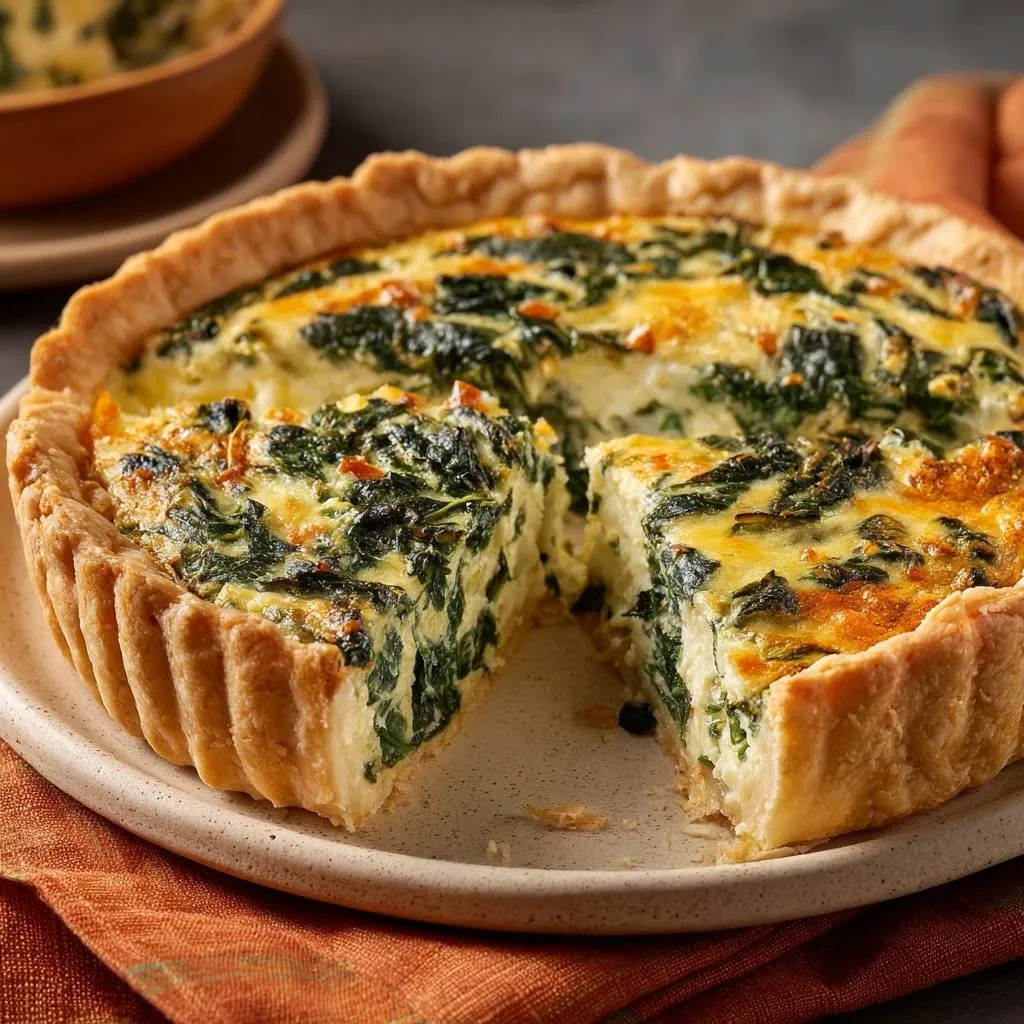
A truly great Deep Dish Spinach and Gruyere Quiche is a feat of culinary architecture. When you pull it from the oven, it shouldn’t look like a flat, sad pancake. Instead, it should boast a towering, two-inch thick custard that stands tall with structural integrity. The contrast between the shatteringly crisp, buttery crust and the silky, weightless interior is what separates a cafe-quality tart from a soggy home-cooked disappointment.
Most people struggle with quiche because they treat it like a simple egg pie, but it’s actually a delicate custard. The “Anti-Soggy Bottom” philosophy is all about moisture management. By mastering the balance between the heavy greens and the rich dairy, you create a slice that is decadent without being heavy. It’s the kind of dish that feels substantial enough for a centerpiece dinner but elegant enough for a high-end brunch.
The secret to this specific recipe lies in the protein-based moisture barrier. I’ve found that even the best-drained spinach can still release a tiny bit of liquid during the long bake. By using a specific egg-white sealing technique on the par-baked crust, you create a hydrophobic shield. This ensures the pastry stays crisp and flaky, even when it’s holding up nearly two pounds of savory custard and cheese.
The Anatomy of a Perfect Custard Ratio
Achieving that signature melt-in-your-mouth texture requires a strict adherence to the 1 egg to 1/2 cup dairy ratio. This specific balance ensures the quiche sets firmly enough to slice but remains creamy on the tongue. If you use too many eggs, the texture becomes rubbery and sulfurous. If you use too much dairy, the center will never fully set, leaving you with a messy, liquid interior.
Heavy cream is absolutely non-negotiable when you’re working with Gruyere. The high fat content in the cream acts as a buffer for the egg proteins, preventing them from curdling or “breaking” into a grainy mess. While milk or half-and-half might seem like a lighter choice, they lack the emulsifying power needed to suspend the spinach and cheese evenly throughout the deep-dish height.
Furthermore, the fat in the cream helps to mellow the earthy, nutty bite of the Gruyere. When these two ingredients meld, they create a luxurious mouthfeel that coats the palate. This high-fat environment also protects the eggs from the intense heat of the oven, ensuring the custard stays smooth rather than turning into a spongy, overcooked scramble.
Essential Components for Deep Dish Spinach and Gruyere Quiche
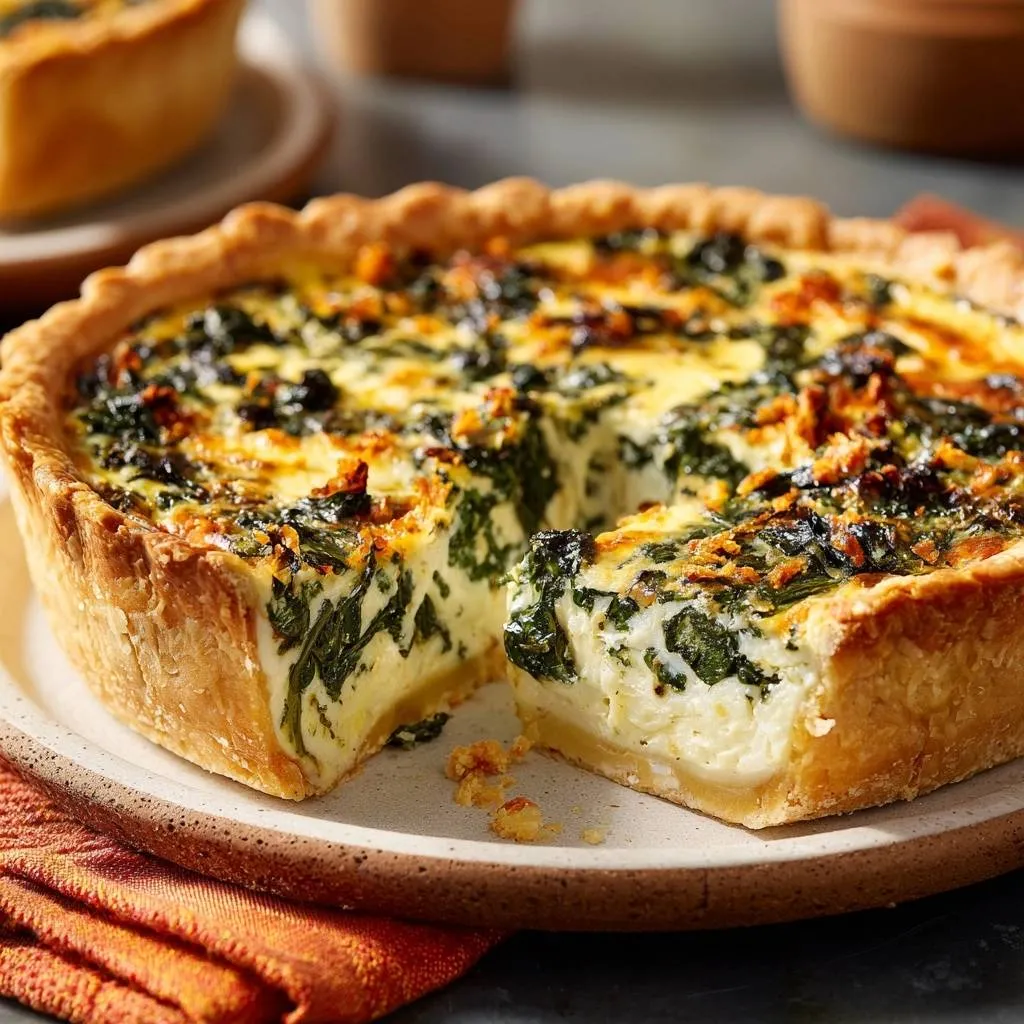
Quality ingredients are the backbone of this dish, starting with the Gruyere. I highly recommend seeking out a cave-aged Gruyere rather than a standard domestic Swiss. The cave-aged variety has a complex, salty crunch and a deep nuttiness that stands up to the iron-rich flavor of the spinach. It melts beautifully without becoming excessively oily, which is vital for a clean slice.
Fresh spinach is vastly superior to frozen for this application. While frozen spinach is convenient, it often turns into a mushy paste that disappears into the custard. Fresh leaves, roughly chopped and quickly wilted, retain a bit of their structural identity. This provides a pleasant textural contrast against the smooth eggs and the flaky pastry shell.
Don’t overlook the ground nutmeg. It might seem like a minor addition, but it acts as the essential flavor bridge between the greens and the dairy. Nutmeg has a unique ability to cut through the richness of the heavy cream while highlighting the sweetness of the wilted spinach. Just a quarter teaspoon transforms the dish from a simple egg tart into a sophisticated savory masterpiece.
Selecting the Right Pastry for Structural Integrity
For a deep-dish application, a sturdy shortcrust pastry is your best friend. While puff pastry is delicious, it often lacks the vertical strength to hold back a heavy custard in a high-sided pan. You want a dough that is high in fat but low in moisture, which results in a crumbly, “short” texture that can support the weight of the filling without sagging.
A high-sided fluted tart pan or a springform pan is necessary to achieve that impressive two-inch height. These pans allow for better heat circulation around the sides of the crust. This ensures that the pastry bakes through completely, becoming a golden, protective vessel for the silky spinach and cheese mixture inside.
The Science of the Moisture Barrier
The most common quiche failure is the “weeping” effect, where liquid pools at the bottom of the crust. This usually happens because the moisture from the filling migrates into the porous, par-baked dough. To prevent this, we use a technique called “Proteic Sealing.” By brushing the hot, par-baked crust with a thin layer of beaten egg white, you create a waterproof film.
As the egg white hits the hot pastry, it coagulates instantly, filling in the microscopic cracks and pores in the dough. This creates a hydrophobic layer that the custard cannot penetrate. Therefore, even if your spinach releases a tiny bit of residual steam, the crust remains protected and stays shatteringly crisp from the first slice to the last.
Step-by-Step: Preparing the Spinach and Crust
Start by roughly chopping your fresh spinach. You want pieces that are large enough to see but small enough to distribute evenly. Melt your butter in a large skillet and toss the spinach in. You aren’t looking to brown the leaves; you just want them to collapse into a vibrant, dark green tangle. This should only take about three minutes over medium heat.
Once wilted, the “Squeeze Test” is the most important part of the entire process. Transfer the spinach to a clean kitchen towel or a fine-mesh strainer. Use your hands to press and squeeze with significant force. You will be shocked at how much green liquid comes out. Keep squeezing until the spinach feels almost dry to the touch and has reduced to about a quarter of its original volume.
If you skip this step, that green liquid will end up in your custard, turning it gray and watery. The goal is to have concentrated spinach flavor without the excess hydration. Once squeezed, fluff the spinach back up with your fingers so it doesn’t go into the quiche as one giant, dense lump. This ensures every bite has a perfect distribution of greens.
Blind Baking for a Shatteringly Crisp Base
Blind baking is the process of pre-cooking the crust before adding the wet filling. Preheat your oven to 375°F, which is the “sweet spot” for setting the dough’s structure. Line the chilled crust with parchment paper and fill it to the brim with pie weights or dried beans. This weight prevents the bottom from puffing up and the sides from slumping down.
Bake for 15 minutes until the edges look set. When you remove the weights and parchment, the bottom of the crust will likely look pale and slightly damp. This is when you brush on your egg white barrier and return it to the oven for another 5 minutes. You are looking for the dough to transition from a translucent, raw appearance to a matte, pale golden finish.
Assembling the Deep Dish Layers
Layering logic is key to a balanced quiche. Instead of mixing everything into the egg liquid, you should layer the dry ingredients directly into the crust. Start with a generous layer of shredded Gruyere on the bottom. This cheese acts as a secondary moisture shield, melting into a delicious barrier that further protects the pastry from the custard.
Next, scatter your squeezed-dry spinach over the cheese. By placing the spinach in the middle, you ensure it stays submerged in the custard, which prevents the leaves from drying out or burning. Pour the egg and cream mixture slowly over the top, allowing it to seep down through the nooks and crannies of the spinach and cheese layers.
Finally, top the quiche with the remaining half-cup of Gruyere. This top layer is crucial for the Maillard reaction. As the quiche bakes, this cheese will brown and bubble, creating a savory, golden crust that provides a beautiful visual contrast to the pale green and yellow interior. It also adds a concentrated hit of salty flavor to every forkful.
Precision Baking: Temperature and the “Jiggle” Test
Once the quiche is assembled, reduce the oven temperature to 350°F. A lower temperature is vital for a deep-dish quiche because it allows the center to cook through without the edges becoming overdone. If the oven is too hot, the custard will puff up like a souffle, which causes the protein structure to stretch and eventually collapse into a dense, rubbery mess.
You are looking for the “uniform jiggle.” When you gently shake the pan, the entire quiche should move as one cohesive unit, similar to set gelatin. If the center ripples like a liquid or looks shiny and wet, it needs more time. However, if the quiche is domed and firm to the touch, it is likely overcooked. Aim for that sweet spot where the edges are golden brown and the center has just a hint of movement.
Troubleshooting Common Quiche Failures
If you end up with an oily surface, it’s usually a sign of using low-quality, pre-shredded cheese. Those products are often coated in potato starch and have a higher oil-to-protein ratio. Always grate your Gruyere fresh from the block for the best emulsion. If the top of your quiche cracks, it means the oven was too hot or the quiche was left in too long, causing the eggs to tighten and pull apart.
A rubbery texture is almost always the result of overcooking. Eggs are very sensitive to heat; once they pass 175°F, the proteins bond too tightly and squeeze out the moisture. If your crust is still soggy despite the egg white trick, check your oven temperature with a thermometer. A cool oven won’t set the crust fast enough to prevent the custard from soaking in.
Why Your Quiche is Weeping After Slicing
If you see liquid pooling on the plate after you slice the quiche, you are witnessing syneresis. This happens when the egg proteins are cooked so hard that they contract and force the liquid out of the protein web. It’s the same reason overcooked scrambled eggs leave a puddle on the plate. To avoid this, use a digital thermometer to pull the quiche when the center hits 170°F.
The carry-over heat will bring it to the perfect final temperature of 175°F while it rests. This ensures the protein web remains flexible and holds onto the cream, resulting in a slice that is moist but never watery. Precision is the difference between a good quiche and a professional-grade savory tart.
Make-Ahead Strategies and Storage Logistics
You can easily prepare the components of this quiche in advance. The crust can be blind-baked and sealed with egg white up to 24 hours ahead of time; just keep it covered at room temperature. You can also sauté and squeeze the spinach a day early and store it in the fridge. However, do not mix the eggs and cream until you are ready to bake, as the salt can begin to break down the egg proteins over time.
Leftover quiche stores beautifully in the refrigerator for up to three days. To preserve the lamination of the crust, never use a microwave for reheating. The microwave will turn the pastry into a soft, chewy mess. Instead, place slices on a baking sheet and warm them in a 325°F oven for about 10 to 15 minutes. This recrisps the butter in the crust and gently warms the custard without overcooking it.
Optimal Side Dishes for Rich Savory Tarts
Because this quiche is incredibly rich due to the heavy cream and Gruyere, you want side dishes that provide a sharp, acidic contrast. A simple salad of bitter greens like frisée, arugula, or radicchio is perfect. Toss the greens in a bright lemon and Dijon mustard vinaigrette to cut through the fat of the custard and cleanse the palate between bites.
Avoid serving heavy starches like roasted potatoes or pasta, as they can make the meal feel overwhelming. Instead, consider a side of quick-pickled red onions or a chilled cucumber salad with white wine vinegar. These bright, acidic elements highlight the earthy notes of the spinach and make the entire dining experience feel much more balanced and refreshed.
Expert Tips for Customizing the Filling
Once you master the base ratio, you can experiment with other “dry” additions. Sautéed leeks are a classic companion to spinach and Gruyere, adding a subtle onion sweetness. Roasted garlic cloves or oil-packed sun-dried tomatoes also work well. The golden rule is that any vegetable you add must be fully cooked and moisture-free before it enters the custard.
If you want to add more depth, try a pinch of smoked paprika or a teaspoon of Dijon mustard whisked into the egg mixture. Just be careful not to overload the quiche with too many “chunky” ingredients. The beauty of a deep-dish quiche is the vast expanse of silky custard; if you add too many fillings, you lose that luxurious, airy texture that makes the dish so special.
The Importance of the 20-Minute Rest
Resist the urge to slice the quiche the moment it comes out of the oven. The 20-minute rest is a mandatory part of the cooking process. During this time, carry-over cooking finishes the center, and the fats in the Gruyere begin to slightly solidify. This “sets” the structure of the slice, allowing you to achieve those clean, skyscraper-tall edges.
If you cut into it too early, the hot custard will be too fluid and will slump onto the plate, losing its impressive deep-dish height. A rested quiche is also much easier to remove from the pan. As the crust cools slightly, it contracts just enough to pull away from the sides of the tart pan, ensuring a perfect release every single time.
Frequently Asked Questions
How should I store and reheat leftovers?
Store leftovers in an airtight container in the refrigerator for up to 3 days. For the best results, reheat slices in a 325°F oven for 10-15 minutes. This method ensures the crust stays crispy. Avoid the microwave, as it will make the pastry soggy and the eggs rubbery. This quiche does not freeze well, as the custard can become grainy and the spinach may release excess water upon thawing.
Why did my quiche turn out watery?
A watery quiche is usually caused by one of two things: under-squeezed spinach or overcooked eggs. If the spinach isn’t bone-dry, it will release moisture into the custard as it bakes. If the eggs are overcooked, the protein structure collapses and squeezes out the liquid (syneresis). Ensure you squeeze the spinach in a kitchen towel until no more liquid escapes and use a thermometer to pull the quiche at 170°F.
Can I use milk instead of heavy cream?
While you can use milk or half-and-half, the result will be significantly different. Heavy cream provides the fat necessary to create a silky, stable custard that doesn’t curdle. If you use milk, the quiche will be more prone to weeping and will have a thinner, less luxurious mouthfeel. If you must substitute, half-and-half is a better choice than whole milk, but heavy cream is the gold standard for a deep-dish quiche.
What can I use if I don’t have Gruyere?
If Gruyere is unavailable, the best substitutes are Emmental, Jarlsberg, or a high-quality sharp Swiss cheese. These cheeses offer a similar melting profile and nutty flavor. You could also use a mix of white cheddar and parmesan for a sharper, saltier kick. Avoid using pre-shredded blends, as the added starches can interfere with the smooth texture of the custard.
Do I really need to blind bake the crust?
Yes, blind baking is essential for a deep-dish quiche. Because the filling is liquid and takes a long time to set, an unbaked crust would become saturated and doughy before it had a chance to crisp up. Blind baking sets the structure of the pastry and, when combined with the egg white seal, ensures a firm, crunchy base that can support the heavy filling without becoming soggy.
Deep Dish Spinach and Gruyere Quiche
Course: Main CourseCuisine: French-AmericanDifficulty: easy8
servings25
minutes55
minutes80
Minutes380
kcalFrench-American
Ingredients
1 deep dish pie crust (chilled, in a fluted tart pan)
12 ounces fresh spinach, roughly chopped
1.5 cups Gruyere cheese, shredded (divided)
5 large eggs
1.5 cups heavy cream
1/2 teaspoon sea salt
1/4 teaspoon black pepper
1/4 teaspoon ground nutmeg
1 tablespoon unsalted butter
1 egg white (for the moisture barrier)
Directions
- Preheat your oven to 375°F (190°C). Line your chilled pie crust with parchment paper and fill with pie weights or dried beans.
- Blind bake the crust for 15 minutes. Remove the weights and parchment, brush the bottom and sides with a thin layer of beaten egg white, and bake for another 5 minutes. This creates a protein-based waterproof seal that prevents the custard from soaking into the pastry.
- While the crust bakes, melt butter in a large skillet over medium heat. Saute the spinach until fully wilted.
- Crucial Step: Place the cooked spinach in a clean kitchen towel or fine-mesh strainer and squeeze out every possible drop of liquid. If the spinach is wet, the quiche will be watery.
- In a medium bowl, whisk together the 5 eggs, heavy cream, salt, pepper, and nutmeg until completely smooth and slightly aerated.
- Spread the squeezed-dry spinach and 1 cup of the Gruyere cheese evenly across the bottom of the par-baked crust.
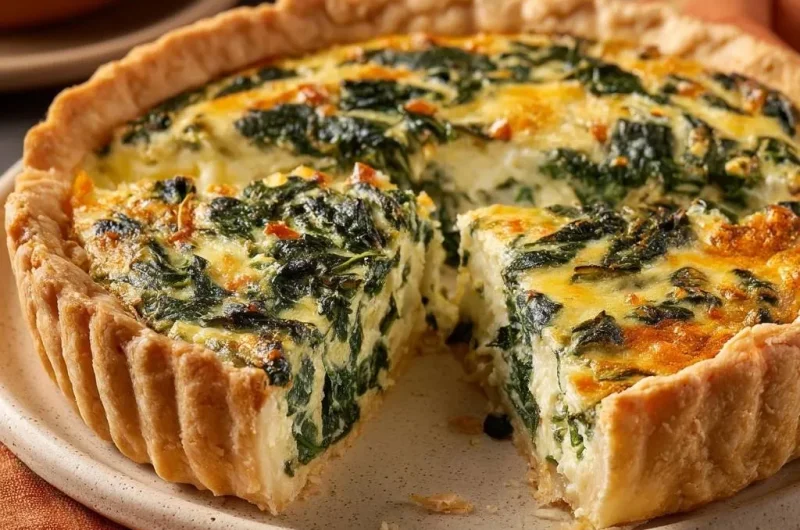
- Pour the egg mixture slowly over the fillings. Top with the remaining 1/2 cup of cheese to create the golden, bubbly crust seen in the image.
- Reduce oven temperature to 350°F (175°C). Bake for 35 to 40 minutes until the edges are set and golden brown, and the center has a slight, uniform jiggle.
- Let the quiche rest for at least 20 minutes before slicing. This allows the custard to set fully and ensures the crust remains crisp.
Notes
- The most important step is squeezing every drop of liquid out of the cooked spinach to prevent a watery filling. Brushing the crust with egg white creates a moisture barrier that keeps the pastry crisp.