
For years, my homemade butternut squash soup would occasionally turn out slightly grainy or thin, despite meticulous preparation-a common frustration among home cooks.
This exceptional recipe for Fall Butternut Squash Soup is the solution, relying on one simple, professional blending trick that guarantees a restaurant-quality, velvety smooth texture every single time.
Get ready for a rich, deeply satisfying, and perfectly smooth soup that will become your favorite autumn staple.
For a similarly smooth result in green soups, check out this vibrant green soup recipe.
Beyond Basic: The Secret to Truly Velvety Fall Butternut Squash Soup
Solving the Grainy Soup Problem (Our Key USP)
The grainy texture in squash soups is caused by vegetable fibers that have not been fully broken down and starches that haven’t been properly emulsified.
Attempting to blend with a standard stick blender or only briefly in a countertop model simply isn’t enough to achieve the necessary breakdown.
Our method focuses on high-shear force and friction to completely dissolve these fibers, eliminating grittiness permanently.
For a truly silken texture, consider the approach in creamy roasted butternut squash soup.
The “Texture Lock-In” Method: Why 2 Minutes on High Speed Matters
The Texture Lock-In Method requires blending the hot soup base on the highest setting for a minimum of 120 seconds (two full minutes).
This extended high-speed process generates friction and heat, which fully breaks down the squash’s cellulose and activates its natural starch.
The resulting texture is a stable emulsion, where the fat, starch, and liquid are bound together, locking in that signature silky, professional finish.
The Unsung Hero: Flavor Depth from Bacon Fat
Butternut squash naturally offers sweetness, which can sometimes make the soup one-dimensional.
By rendering crispy bacon and using a small amount of the residual bacon fat to sauté the aromatics, we introduce a vital layer of savory, smoky richness.
This addition provides the crucial counterpoint of umami, deepening the flavor profile significantly beyond standard vegetarian versions.
Essential Ingredients for Your Fall Butternut Squash Soup
Selecting and Prepping Butternut Squash
Choose a butternut squash that feels heavy for its size, indicating dense flesh and good moisture content; avoid any with deep cuts or mold spots.
Roasting the squash is essential, so only slice it in half lengthwise and remove the seeds before cooking.
Roasting the large pieces ensures the maximum concentration of natural sugars, giving the soup a deep, caramel-like sweetness.
Mastering the Base: Broth and Aromatics
Always opt for low-sodium chicken or vegetable broth to control the seasoning precisely.
The base flavor relies on properly sautéed yellow onion, which must be cooked until fully softened (translucent) but not allowed to brown, which would add bitterness.
Garlic should only be added for the last 60 seconds of cooking the aromatics, ensuring it becomes fragrant but never burns.
The Finishing Touch: Cream, Bacon, and Chives
A small amount of heavy cream or half-and-half adds essential mouthfeel and luxurious richness to the final soup.
The crispy bacon crumbles and fresh chives are critical garnishes; they provide a much-needed textural contrast and fresh, sharp flavor to balance the sweet, rich soup base.
What Goes Well With This Soup?
Round out your meal with these satisfying dishes.
- For a heartier meal, consider making fluffy loaded garlic mashed potatoes, perfect for soaking up any extra soup.
- If you’re craving another comforting bowl, try the loaded Philly cheesesteak soup for a different flavor profile.
For a dairy-free alternative, full-fat coconut milk or homemade cashew cream works excellently, offering a similar richness without altering the flavor profile significantly.
Tools for the Task: Achieving Professional Soup Consistency
Why a High-Speed Blender is Non-Negotiable
The foundation of this silky Fall Butternut Squash Soup is the high-speed blender; standard immersion blenders simply cannot achieve the necessary blade speed and friction required for the Texture Lock-In Method.
A powerful countertop blender, such as a Vitamix or Blendtec, ensures the complete breakdown of fibrous material and the formation of a stable emulsion.
Stockpot vs. Dutch Oven: Choosing Your Vessel
A heavy-bottomed Dutch oven is ideal for the initial steps because its excellent heat retention ensures even cooking of the bacon and aromatics without scorching.
However, a standard large stockpot with a thick base works perfectly well for the simmering stage, provided it is large enough to handle the 4 cups of broth and squash flesh.
Optional Equipment: The Fine-Mesh Sieve
While the high-speed blend usually eliminates all trace of graininess, a fine-mesh sieve provides an insurance policy for absolute perfection.
If you are serving the soup for a special occasion or using a less powerful blender, carefully push the blended soup through the sieve into the pot to catch any minute solids.
The Step-by-Step Guide to Perfect Fall Butternut Squash Soup
-
Roasting the Squash: Building Maximum Sweetness (Step 1)
Preheat your oven to 400°F and prepare the squash by halving it lengthwise and scooping out the seeds.
Drizzle the cut sides with oil and roast cut-side down for 40 to 50 minutes until truly fork-tender; this caramelization of the sugars is what creates the deep, complex flavor of the soup.
Once cooled slightly, scoop all the soft, flavorful flesh from the rind and set it aside, ready for the pot.
-
Building Depth: Sautéing Aromatics in Bacon Fat (Step 2)
Cook the four slices of bacon in your pot over medium heat until they are extremely crispy; remove the bacon, crumble it, and reserve it for garnish, saving exactly one tablespoon of the rendered fat in the pot.
Add the chopped onion to the reserved fat and sauté slowly for 5 to 7 minutes until the pieces are fully softened and translucent, forming the savory foundation.
Introduce the minced garlic only after the onions have softened, cooking for just 60 seconds until fragrant-this prevents bitterness.
-
The Simmer: Integrating Flavors (Step 3)
Add the reserved roasted squash flesh, low-sodium broth, salt, and pepper to the pot, ensuring the squash is mostly submerged.
Bring the mixture up to a gentle boil, then immediately reduce the heat and maintain a low simmer for 10 minutes.
This simmer time is crucial for allowing the smoky bacon fat, the sweet squash, and the savory aromatics to meld completely, creating a cohesive, well-rounded taste.
-
Executing the Texture Lock-In Method (Step 4)
SAFETY WARNING: Blending hot liquids requires extreme caution. Never fill the blender more than halfway, and always secure the lid, leaving the small vent open or slightly ajar (covered with a dish towel) to release steam pressure.
Transfer the hot soup mixture to the high-speed blender, starting on the lowest speed to prevent splashing, then gradually increasing to the highest setting.
Blend for a full 120 seconds on high speed without stopping; this long, intense blending is the non-negotiable step that locks in the velvety smooth texture.
-
The Final Finish and Serving (Steps 5 & 6)
Return the perfectly smooth soup to the pot and heat through over very low heat.
Stir in the 1/4 cup of heavy cream or half-and-half; adding the cream off the direct heat or at low temperature prevents the dairy from curdling or separating.
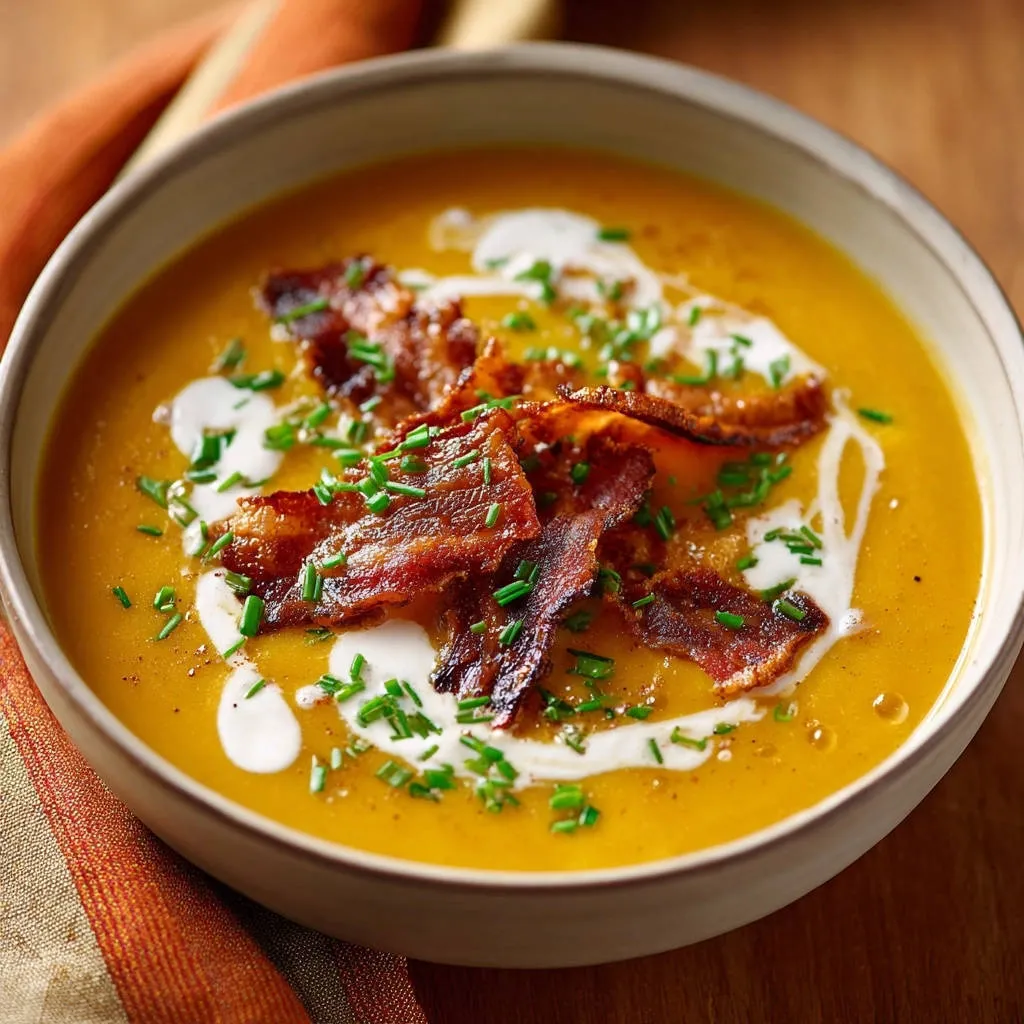
Ladle the beautiful orange soup into bowls, finishing each serving with a light swirl of extra heavy cream, a generous topping of the crispy bacon crumbles, and a sprinkle of fresh chives for visual appeal and fresh flavor.
Troubleshooting and Pro-Tips for Butternut Squash Soup Success
Problem: The Soup Tastes Bland or Flat
If the soup lacks vibrancy after blending and finishing, it likely needs acid or a boost in seasoning.
A quick fix is adding a tablespoon of fresh lemon juice or a splash of white wine vinegar to brighten the flavor profile, contrasting the rich sweetness.
Alternatively, if it is too sweet, a small pinch of cayenne pepper or a final boost of salt will bring the flavors into balance.
Pro Tip: The Importance of Seasoning in Layers
Never rely on one final seasoning step. You should season the bacon and aromatics lightly before adding the broth.
Season the soup again after the 10-minute simmer, and finally, do a taste test after the heavy cream is incorporated.
This layered seasoning approach ensures every component of the Fall Butternut Squash Soup base is perfectly flavored.
Problem: The Soup is Too Thin or Too Thick
If your soup is too thick after blending, simply whisk in warm broth, one quarter-cup at a time, until the desired consistency is achieved.
If the soup is too thin (which is rare with the Texture Lock-In Method), return it to the heat and simmer gently, uncovered, for an additional 10 to 15 minutes to allow some liquid to evaporate and concentrate.
Make It Ahead, Store It Right: Tips for Meal Prep and Freezing
Staging the Recipe for Optimal Make-Ahead Prep
This Fall Butternut Squash Soup is an ideal meal prep item, but it should be stored in stages.
Complete the recipe entirely through the blending step (Step 4), creating a perfect soup base without any dairy.
Store the base in the refrigerator, and then gently reheat it, stirring in the cream and adding the garnishes just before serving.
Storing Leftovers Safely in the Refrigerator
Once cooled, transfer leftover soup into an airtight container and refrigerate promptly.
The finished soup, including the cream, will keep safely in the fridge for up to 3 to 4 days.
Freezing Instructions for Long-Term Storage
For long-term storage, always freeze the soup before adding the heavy cream.
Dairy products tend to separate and become slightly grainy when frozen and thawed, compromising the velvety texture we worked hard to achieve.
Cool the base completely, pour it into freezer-safe containers (leaving headspace), and freeze for up to three months; thaw overnight and stir in the cream upon reheating.
Best Pairings: What to Serve Alongside Your Fall Butternut Squash Soup
Ideal Crunchy and Savory Companions
Gourmet Grilled Cheese: Pair the soup with a savory sandwich featuring sharp cheddar and Gruyère on sourdough for a classic, comforting pairing.
Crusty Bread and Compound Butter: A thick slice of toasted artisan bread is perfect for dipping and soaking up the rich liquid.
Arugula Salad: Serve a light, peppery salad tossed with balsamic vinaigrette and crumbled goat cheese to cut through the richness of the soup.
Grape juice and Beverage Recommendations
For grape juice, select something that offers bright acidity and subtle fruit notes that won’t overpower the squash.
A dry, slightly off-dry sparkling grape juice is an excellent choice, complementing the squash’s sweetness and the bacon’s savoriness.
For non-alcoholic options, try sparkling apple cider or a homemade ginger-lemon tonic to refresh the palate between spoonfuls.
Frequently Asked Questions About Homemade Butternut Squash Soup
Can I make this Fall Butternut Squash Soup vegetarian or vegan?
Absolutely. To make this recipe vegetarian, simply omit the bacon and use high-quality vegetable broth, sautéing the aromatics in olive oil or butter instead of bacon fat.
For a vegan version, use vegetable broth and substitute the heavy cream with full-fat canned coconut milk or store-bought cashew cream for richness.
Is it better to roast or boil the squash for this recipe?
Roasting is definitively superior for this recipe and any savory squash dish.
Boiling the squash adds excess water and dilutes the flavor, while roasting concentrates the natural sugars, resulting in a deeper, more flavorful, and less watery soup.
How far in advance can I prepare the roasted squash flesh?
The roasted butternut squash flesh can be prepared up to three days in advance.
Once cooled, store the scooped flesh in an airtight container in the refrigerator until you are ready to proceed with Step 2 (cooking the aromatics).
Ready to Cozy Up? Share Your Fall Butternut Squash Soup Creation!
The quest for the perfectly smooth squash soup is finally over. By adopting the high-speed “Texture Lock-In” method, you guarantee an exquisite consistency that elevates this autumnal staple to gourmet status.
This recipe provides not just comfort, but confidence in the kitchen. The savory notes from the bacon fat combined with the roasted squash create an irresistible depth of flavor.
Try this ultimate Fall Butternut Squash Soup, snap a photo of that beautiful, creamy swirl, and share your results. Happy cooking!

Butternut Squash Soup
Course: Soups-StewsCuisine: InternationalDifficulty: medium6
servings20
minutes1
hour240
kcal80
minutesThis recipe guarantees a professional-quality, velvety smooth butternut squash soup. The key is implementing a specific high-speed blending technique that breaks down vegetable fibers completely, eliminating all traces of grittiness. Finished with crispy bacon and heavy cream, this is the ultimate cold-weather comfort food.
Ingredients
1 large butternut squash (about 3 pounds)
1 tablespoon olive oil
1 yellow onion, roughly chopped
2 cloves garlic, minced
4 cups low-sodium chicken or vegetable broth
1 teaspoon salt
1/2 teaspoon black pepper
1/4 cup heavy cream or half-and-half, plus extra for swirling
4 slices of bacon
1 tablespoon chopped fresh chives
Directions
- Prepare the Squash: Preheat your oven to 400 degrees F. Carefully slice the squash in half lengthwise and scoop out the seeds. Drizzle the cut sides with a touch of oil and place them cut-side down on a baking sheet. Roast for 40 to 50 minutes, or until the squash is fork-tender. Once cooled slightly, scoop the flesh from the rind and set aside.
- Cook Aromatics: While the squash roasts, cook the bacon in a large stockpot or Dutch oven over medium heat until very crispy. Remove the bacon with a slotted spoon, reserving 1 tablespoon of the bacon fat in the pot. Crumble the bacon and set aside for garnish. Add the chopped onion to the pot and sauté in the bacon fat until softened, about 5 to 7 minutes. Add the minced garlic and cook for 1 minute until fragrant.
- Simmer: Add the roasted squash flesh, broth, salt, and pepper to the pot. Bring the mixture to a gentle boil, then reduce heat and simmer for 10 minutes to allow the flavors to meld.
- The Texture Lock-In Method (Guaranteed Velvety Smooth): Transfer the hot soup mixture carefully to a high-speed blender. This step is the key to that silky texture. Start blending on low speed and gradually increase to the highest setting. Blend the soup on high for a full 2 minutes. Do not stop early. This long, high-speed blend is crucial because it breaks down the vegetable fibers completely and emulsifies the natural starch and fat, creating a perfectly velvety smooth texture. If you are concerned about grittiness, you may optionally strain the soup through a fine-mesh sieve after blending and before returning it to the pot.
- Finish and Serve: Return the blended soup to the pot over low heat. Stir in the 1/4 cup of heavy cream or half-and-half until fully incorporated and heated through.
- Ladle the soup into bowls. Drizzle with a swirl of extra heavy cream, top generously with the crispy bacon crumbles, and sprinkle with fresh chives. Serve immediately.
Notes
- The critical step for texture is blending the soup on the highest speed for a full 2 minutes.