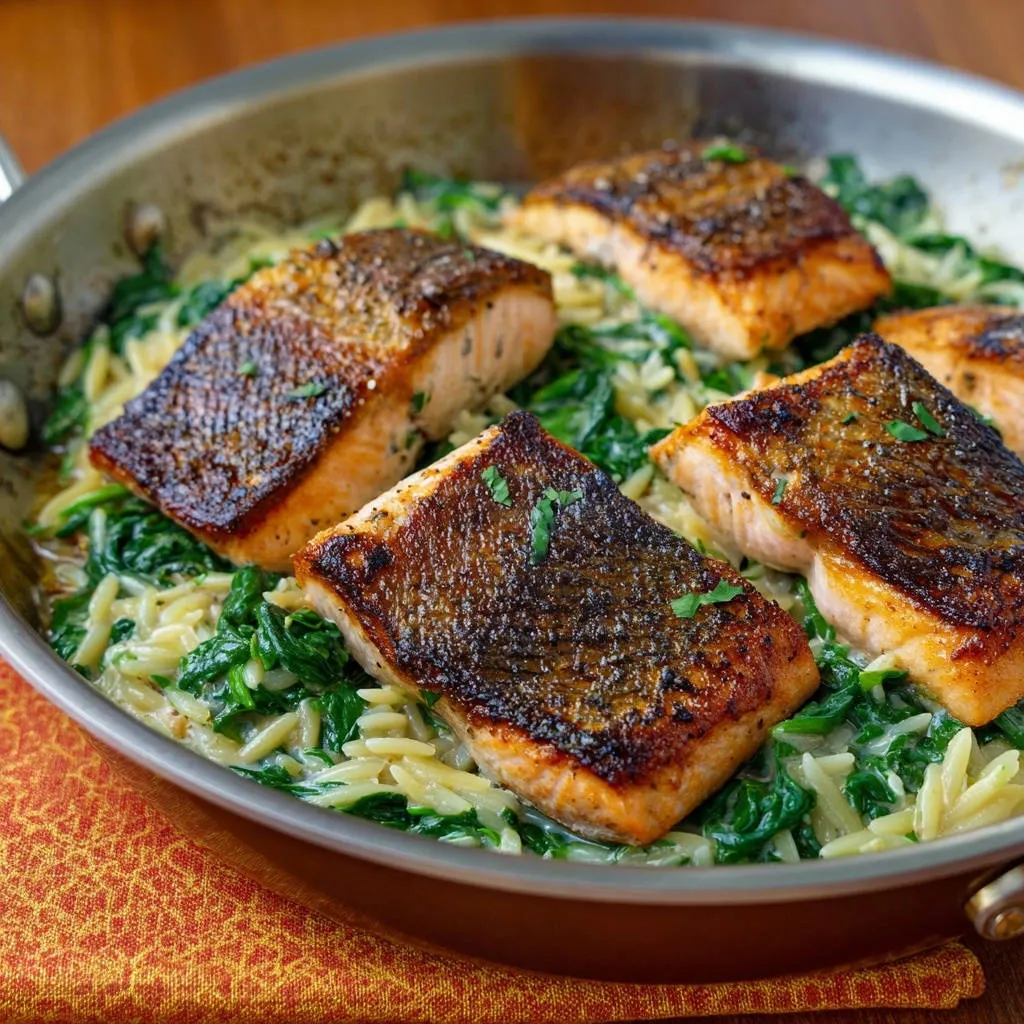
Achieving truly crispy salmon skin without overcooking the fish used to feel like a kitchen myth, but I’ve finally cracked the code. My recipe for Pan-Seared Salmon with Creamy Orzo & Spinach reveals the simple secrets to that coveted crackle and perfectly tender flesh, making restaurant-quality weeknight dinners a delicious reality. Paired with a luscious, cheesy orzo and vibrant spinach, this dish is a complete meal that truly satisfies.
Why This Pan-Seared Salmon & Creamy Orzo Is a Must-Try
The Irresistible Crispy Skin You’ve Dreamed Of
This recipe focuses on meticulous steps that guarantee a shatteringly crisp salmon skin, every single time. It’s about precision drying, the right pan temperature, and a specific pressing technique that prevents curling and maximizes contact.
A Complete, Flavorful Meal in One Pan
Beyond the flawless salmon, this dish offers a beautifully balanced meal in one skillet. The rich, creamy orzo provides a comforting base, perfectly complementing the bright spinach and the savory fish.
Elevating Weeknight Dinners, Effortlessly
Despite its gourmet appeal, this Pan-Seared Salmon with Creamy Orzo & Spinach is surprisingly straightforward. Most of the cooking happens in one pan, simplifying cleanup and making it ideal for busy evenings.
It’s a quick culinary escape, transforming ordinary weeknights into something truly special without hours in the kitchen.
Gather Your Ingredients: The Building Blocks of Flavor
For the Perfectly Pan-Seared Salmon Fillets
Begin with four 6-ounce salmon fillets, skin-on. High-quality, fresh salmon is paramount for flavor and texture, and the skin is absolutely essential for achieving that glorious crispness.
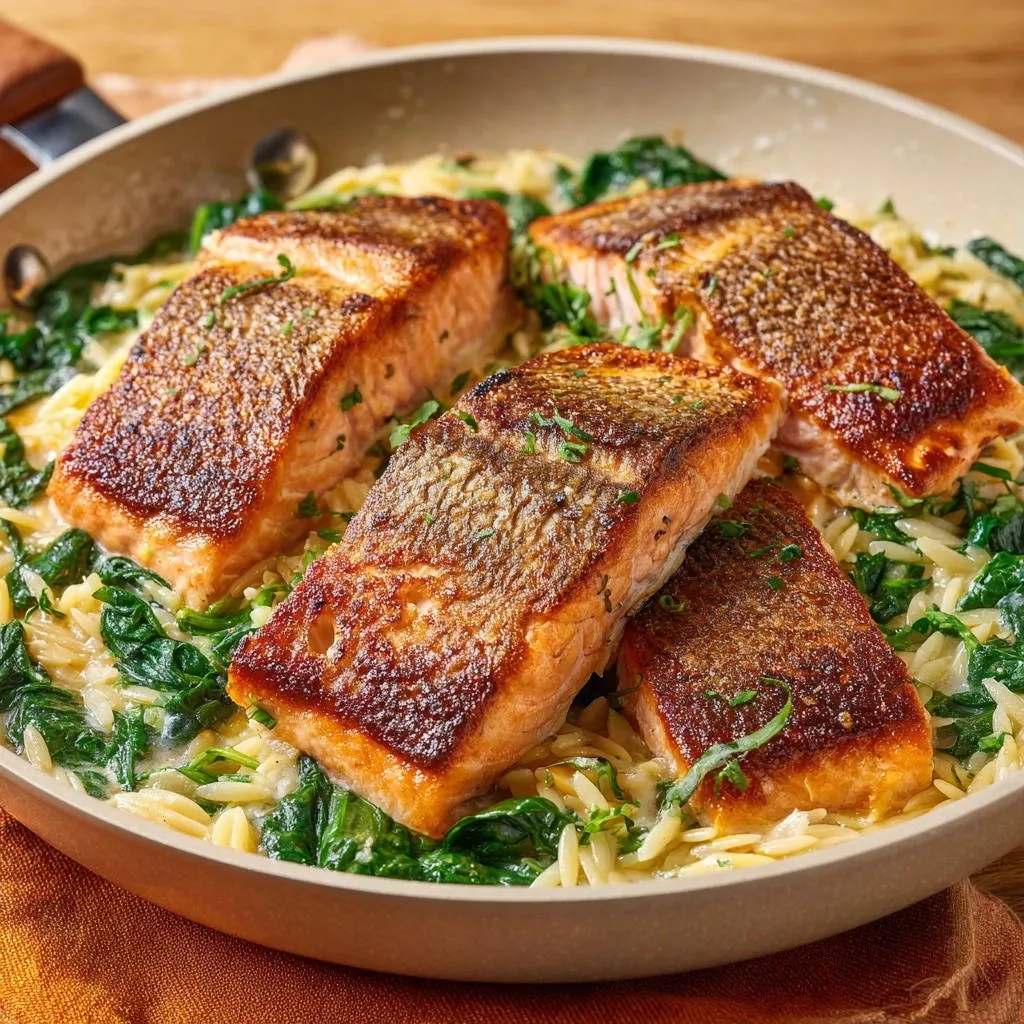
A generous seasoning of salt and freshly ground black pepper enhances the salmon’s natural richness, creating a simple yet profound flavor profile.
Crafting the Creamy Orzo & Spinach Base
One cup of orzo pasta forms the foundation, its small, rice-like shape absorbing flavors beautifully to create a creamy texture. You’ll want it cooked al dente for the best mouthfeel.
Unsalted butter and half-and-half (or whole milk) provide a luscious, velvety richness to the sauce. These dairy elements bind the ingredients and create a comforting, indulgent feel.
Four cups of fresh spinach wilt down into the orzo, adding vibrant color, essential nutrients, and a subtle earthy sweetness that balances the dish.
Pantry Staples and Fresh Finishing Touches
Minced garlic infuses the sauce with aromatic depth. Chicken or vegetable broth adds a crucial liquid base and savory complexity to the orzo.
Grated Parmesan cheese melts into the sauce, contributing a salty, umami-rich creaminess. Its sharp flavor is indispensable for the cheesy orzo.
Finally, fresh chopped parsley serves as a bright, herbaceous garnish. It adds a pop of color and a fresh, clean finish to the rich Pan-Seared Salmon with Creamy Orzo & Spinach.
Essential Kitchen Tools for Salmon Success
Your Skillet Choice: The Crispy Skin Catalyst
A large, heavy-bottomed, oven-safe skillet is your most critical tool. Cast iron or stainless steel are ideal because they retain heat exceptionally well and distribute it evenly.
This consistent heat is fundamental for developing that perfect, deep golden, crispy salmon skin without burning or uneven cooking.
Standard Prep & Cooking Equipment
You’ll need a sturdy spatula for pressing down the salmon and flipping it safely. A cutting board and sharp knife are essential for prepping your garlic and parsley.
Measuring cups and spoons ensure accuracy, while a whisk helps combine the creamy orzo sauce ingredients smoothly. Paper towels are surprisingly vital for thoroughly drying the salmon.
Step-by-Step: Mastering Pan-Seared Salmon with Creamy Orzo & Spinach
Cook the Orzo & Prepare Your Workspace
Begin by cooking 1 cup of orzo pasta according to its package directions until it’s perfectly al dente. This ensures a pleasant bite without being mushy. Once cooked, drain the orzo thoroughly and set it aside; excess water can dilute your creamy sauce.
Use this time to gather and measure all your remaining ingredients. Having everything prepped (mise en place) makes the rest of the cooking process smooth and stress-free.
Prepare and Season the Salmon Fillets
Pat your salmon fillets extremely dry on all sides using paper towels, focusing especially on the skin. This step is non-negotiable for crispy skin, as moisture creates steam rather than sizzle. Season generously with salt and freshly ground black pepper.
Achieve the Perfect Pan Temperature
Place a large, heavy-bottomed, oven-safe skillet (cast iron or stainless steel is best) over medium-high heat. Let it preheat for 3 to 5 minutes until it’s very hot; a few drops of water should sizzle and evaporate instantly. Add 2 teaspoons of olive oil, swirling to coat the pan evenly.
Sear Skin-Side Down & The Pressing Technique
Carefully place the salmon fillets, skin-side down, into the hot skillet. Immediately press down gently but firmly on each fillet with a spatula for 10 to 15 seconds. This critical technique ensures maximum, even contact between the skin and the hot pan, preventing curling and guaranteeing uniform crispness.
Do not move the salmon after this initial press. Let it cook undisturbed for 4 to 6 minutes, or until the skin is a deep golden brown and visibly crispy. You’ll notice the salmon easily releases from the pan, and the flesh will have cooked up about halfway from the bottom.
Flip and Finish Cooking
Flip the salmon fillets to the flesh side. Cook for another 2 to 4 minutes, depending on their thickness, until the salmon reaches your desired doneness. The internal temperature should be 145°F, or the flesh should flake easily with a fork.
For more on achieving that perfect finish, check out this guide to pan-seared salmon with orzo and spinach.
Remove the perfectly seared salmon from the skillet and transfer it to a plate. Allow it to rest while you finish the orzo, preserving its juiciness.
Sauté Aromatics & Deglaze the Pan
In the same skillet (don’t clean it!), melt the 2 tablespoons of unsalted butter over medium heat. Add the minced garlic and cook for about 30 seconds until fragrant, stirring constantly to prevent burning.
Pour in the chicken or vegetable broth, bringing it to a gentle simmer. Use a wooden spoon to scrape up any browned bits from the bottom of the pan – these are invaluable flavor reservoirs!
Create the Creamy Base
Stir in the 1/4 cup of half-and-half (or whole milk) and 2 tablespoons of grated Parmesan cheese. Continue to stir until the cheese is melted and fully combined, creating a smooth, rich sauce.
Combine Orzo & Spinach
Add the cooked orzo and the 4 cups of fresh spinach to the skillet with the creamy sauce. Cook, stirring gently, for about 2 to 3 minutes, or until the spinach has wilted completely and the sauce has slightly thickened, coating the orzo beautifully.
Plate and Garnish
Divide the luscious creamy orzo and spinach mixture among your serving plates. Carefully top each portion with a perfectly crispy-skinned salmon fillet. For a vibrant finish, garnish generously with fresh chopped parsley.
Serve your magnificent Pan-Seared Salmon with Creamy Orzo & Spinach immediately, allowing everyone to savor the contrasting textures and harmonious flavors.
Chef’s Secrets for Irresistible Crispy-Skinned Salmon
The Power of Patting Dry: Why Moisture is the Enemy
Moisture on the salmon skin acts as a barrier, causing the fish to steam rather than sear. Thoroughly patting the skin dry with paper towels ensures direct contact with the hot oil, allowing it to crisp beautifully.
This crucial step creates the perfect environment for the Maillard reaction, developing that desirable deep golden-brown crust and rich flavor.
Hot Pan, Happy Skin: Achieving That Golden Crust
Preheating your heavy-bottomed skillet to a very high temperature (medium-high) is non-negotiable. An adequately hot pan creates an immediate sizzle and sear on the skin, forming that incredible crust rapidly.
A cold or lukewarm pan will result in soggy skin and potentially overcooked fish as it takes too long to reach the ideal searing temperature.
The “Press Down” Technique: Maximum Skin Contact
Immediately after placing the salmon skin-side down, gently but firmly press each fillet with a spatula for 10-15 seconds. This prevents the skin from curling up, ensuring every inch makes even contact with the hot pan.
Maximum surface area contact translates directly to uniformly crispy skin across the entire fillet, a hallmark of perfectly seared salmon.
Knowing When to Flip: The Release Test
Resist the urge to move the salmon too early. The fish will naturally release from the pan once the skin is perfectly seared and crispy, signaling it’s ready to flip.
If it sticks, it’s not ready! Forcing it will tear the skin. Wait until it easily glides when gently nudged before flipping.
Don’t Overcook: Perfectly Flaky Flesh Every Time
Salmon cooks quickly, especially when starting skin-side down. The visual cue of the flesh cooking halfway up the sides is a great indicator of when to flip.
Aim for an internal temperature of 145°F (63°C) for medium-doneness, or cook until the thickest part flakes easily with a fork. Overcooking leads to dry, tough salmon.
Perfect Pairings & Presentation Ideas
What to Serve Alongside
While this Pan-Seared Salmon with Creamy Orzo & Spinach is a complete meal, a simple accompaniment can elevate the experience. A light, crisp green salad dressed with a bright vinaigrette offers a refreshing contrast to the richness.
Round Out Your Meal
Consider these dishes to complement your salmon, offering fresh flavors and satisfying textures.
- For a vibrant start, try the Strawberry Avocado Quinoa Salad, bringing bright fruit and creamy avocado to the table.
- Another great option is the Loaded Chicken Chickpea Spinach Salad, offering protein and a hearty mix of greens.
Crusty artisan bread is perfect for soaking up any leftover creamy orzo sauce, ensuring not a single drop of flavor is missed.
Garnishing for Impact
Fresh chopped parsley is a classic garnish that adds a vibrant pop of color and herbaceous freshness. It brightens the dish visually and aromatically.
Consider a squeeze of fresh lemon juice just before serving for an extra layer of brightness, or a sprinkle of finely grated lemon zest to enhance the overall flavor profile.
For an even brighter citrus note, check out this lemon spinach orzo.
Make-Ahead, Storage, and Reheating Tips
Prepping Ahead for Quick Meals
You can cook the orzo pasta ahead of time and store it in an airtight container in the refrigerator for up to 2-3 days. This significantly cuts down on active cooking time.
Mince your garlic and chop your parsley in advance, keeping them stored separately in small airtight containers. This streamlines the assembly process for the creamy orzo.
Storing Leftovers Safely
Store any leftover Pan-Seared Salmon with Creamy Orzo & Spinach in separate airtight containers if possible, or combined if space is an issue. Refrigerate within two hours of cooking.
Consume leftovers within 2-3 days for the best quality and safety. Prompt and proper storage is key to enjoying this delicious dish again.
Reheating Without Sacrificing Quality
For the orzo, gently reheat on the stovetop over low heat, adding a splash of chicken broth or milk to restore its creamy consistency. Stir occasionally to prevent sticking.
Reheat salmon gently in a preheated oven at 275°F (135°C) for 10-15 minutes, or in an air fryer at 300°F (150°C) for 5-7 minutes. This method helps retain moisture and can revive some crispness in the skin.
Troubleshooting Your Pan-Seared Salmon & Orzo
Problem: Salmon Skin Isn’t Crispy
Solution: Ensure your salmon fillets are extremely dry before seasoning – moisture is the enemy of crispiness. Your skillet must be very hot before adding the oil and salmon; don’t rush the preheating. Also, remember to firmly press the salmon down initially to maximize skin contact and avoid moving it during the first sear.
Problem: Salmon is Dry or Overcooked
Solution: Salmon cooks quickly. Monitor it closely, especially during the second side cook. Use visual cues (flesh cooked halfway up the sides) and consider an instant-read thermometer (target 145°F). Thicker fillets will need slightly more time; thinner ones less. Overcooking by even a minute can dry it out.
Problem: Orzo Sauce is Too Thin or Thick
Solution: If the sauce is too thin, let it simmer gently for a few more minutes to reduce and thicken naturally. For a quicker fix, mix a tiny bit of cornstarch with cold water (a slurry) and whisk it in gradually. If too thick, simply add a splash more broth or half-and-half until it reaches your desired consistency.
Problem: Lack of Flavor in the Orzo
Solution: Don’t be shy with seasoning! Taste and adjust the salt and pepper levels before adding the orzo. Ensure you’re deglazing the pan thoroughly to capture all those flavorful browned bits. A little extra Parmesan cheese or a fresh squeeze of lemon juice can also significantly boost the taste.
Frequently Asked Questions (FAQs)
Can I use skinless salmon fillets?
Yes, you can use skinless salmon fillets, but you won’t achieve the signature crispy skin. Cook them in the same manner, searing for 3-5 minutes per side, until they flake easily and reach an internal temperature of 145°F (63°C).
While delicious, the texture will be different without the crackling skin, which is a highlight of this particular Pan-Seared Salmon with Creamy Orzo & Spinach recipe.
What if I don’t have half-and-half?
You can easily substitute half-and-half with whole milk for a slightly lighter sauce, or heavy cream for a richer, more indulgent result. Plant-based alternatives like full-fat coconut milk (for a subtle flavor change) or unsweetened almond milk can also work, though they may alter the final creaminess.
Can I add other vegetables to the orzo?
Absolutely! This creamy orzo base is wonderfully versatile. Consider adding finely diced zucchini, asparagus tips, or frozen peas (added with the spinach). Cherry tomatoes, halved, are also a fantastic addition, stirring them in towards the end.
Is this recipe gluten-free?
As written, this recipe is not gluten-free due to the orzo pasta. However, you can easily make it gluten-free by using a certified gluten-free orzo pasta. All other ingredients listed (salmon, oil, salt, pepper, spinach, butter, garlic, broth, half-and-half, Parmesan, parsley) are typically gluten-free.
What’s the best way to check salmon doneness?
The most reliable way is with an instant-read thermometer inserted into the thickest part; aim for 145°F (63°C). Visually, the salmon should flake easily with a fork, and the center should transition from translucent to opaque, with a slight moistness remaining.
Don’t wait until it’s completely dry, as that indicates overcooking. A perfectly cooked salmon will still have a beautiful, tender succulence.
Your Turn to Create: Share Your Salmon Success!
Now that you’re equipped with all the secrets and expert tips, it’s your turn to create this spectacular Pan-Seared Salmon with Creamy Orzo & Spinach.
Experience the joy of perfectly crispy salmon skin, tender flaky flesh, and a rich, comforting orzo that will impress everyone at your table. Don’t be shy – dive in, experiment, and make this dish your own!
I’d love to hear about your culinary triumphs. Share your results, tips, or questions in the comments below, and let’s celebrate mastering this truly exceptional meal together!
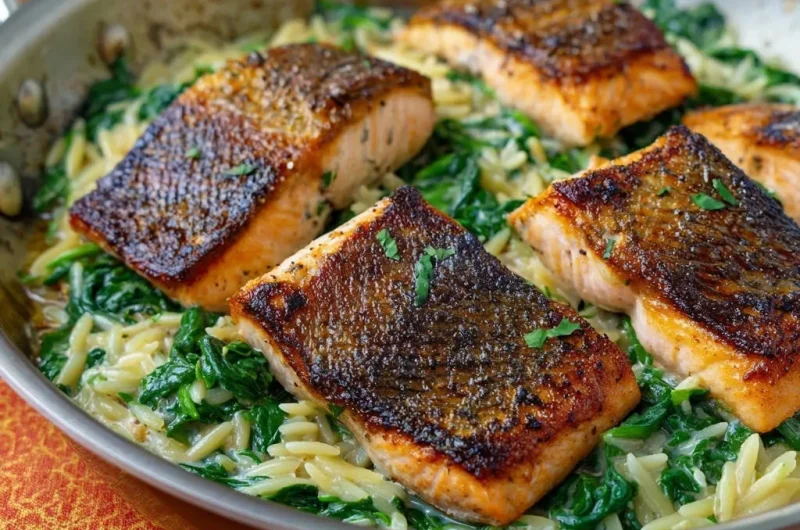
Pan-Seared Salmon
Course: Main CourseCuisine: AmericanDifficulty: easy4
servings15
minutes25
minutes750
kcal40
minutesMaster the art of crispy-skinned salmon with this foolproof recipe. Paired with a luscious creamy orzo and fresh spinach, it’s a complete, satisfying meal that’s perfect for any weeknight.
Ingredients
4 (6-ounce) salmon fillets, skin-on
1 tablespoon olive oil, plus 2 teaspoons for cooking
Salt and freshly ground black pepper, to taste
1 cup orzo pasta
4 cups fresh spinach
2 tablespoons unsalted butter
2 cloves garlic, minced
1/2 cup chicken broth (or vegetable broth)
1/4 cup half-and-half (or whole milk)
2 tablespoons grated Parmesan cheese
2 tablespoons fresh parsley, chopped, for garnish
Directions
- Cook orzo pasta according to package directions until al dente. Drain well and set aside.
- Prepare the salmon: Pat salmon fillets extremely dry on all sides with paper towels, paying extra attention to the skin. This is key for crispy skin! Season generously with salt and freshly ground black pepper.
- Heat a large, heavy-bottomed, oven-safe skillet (like stainless steel or cast iron) over medium-high heat for 3 to 5 minutes until it is very hot. Add 2 teaspoons of olive oil to the hot pan.
- Carefully place the salmon fillets, skin-side down, into the hot skillet. Immediately press down gently but firmly on each fillet with a spatula for about 10 to 15 seconds. This ensures maximum skin contact with the pan. Do not move the salmon after this initial press. Let it cook undisturbed for 4 to 6 minutes, or until the skin is deep golden brown and crispy, and the salmon easily releases from the pan. You will see the salmon flesh cook up the sides about halfway.
- Flip the salmon fillets and cook for another 2 to 4 minutes, depending on thickness, or until the salmon reaches your desired doneness (internal temperature of 145F). Remove the salmon from the skillet and set aside on a plate.
- In the same skillet, melt the butter over medium heat. Add the minced garlic and cook for about 30 seconds until fragrant, being careful not to burn it.
- Pour in the chicken broth, bringing it to a gentle simmer. Scrape up any browned bits from the bottom of the pan with a wooden spoon. Stir in the half-and-half and Parmesan cheese until combined.
- Add the cooked orzo and fresh spinach to the skillet. Cook, stirring gently, until the spinach wilts and the sauce slightly thickens, about 2 to 3 minutes.
- Divide the creamy orzo and spinach mixture among plates. Top each serving with a crispy-skinned salmon fillet. Garnish with fresh chopped parsley and serve immediately.
Notes
- For perfectly crispy salmon skin, ensure it’s completely dry before searing and resist the urge to move the fillets too much in the pan during the initial cooking. When adding the spinach, let it wilt down a bit before stirring it into the creamy orzo to prevent it from becoming watery.